My main research project, started with my PhD, has been an empirical and historical analysis of how authenticity shapes taste, consumption practices, and work aspirations in late modern capitalism, through the case study of the neo-craft economy.
The main contributions my project has advanced are:
Contextualise the current resurgence of neo-craft consumption and work in a longue durée analysis of the dialectics between alienation and authenticity in modern societies and capitalist transformations (Gerosa, 2024; Gerosa, 2022).
Introduce the concept of aesthetic regime of consumption to better integrate the sphere of consumption in analyses of overall capitalist configurations (Gerosa, 2024).
Develop a framework in order to better bridge the macro-, meso-, and micro-level of analysis in the field of consumption, through the concepts of aesthetic regime of consumption, economic imaginaries of consumption, and taste dealers(Gerosa, 2024; Gerosa, 2021).
Provide a conceptualisation of neo-craft work and neo-craft industries, situating them in the current socio-economic developments in Western societies (Gandini & Gerosa, 2023; Gerosa, 2025).
Highlight the relevance of retailers, eatery owners and artisans as taste dealers: intermediaries that translate the broader paradigms of consumption into consumption goods, today through the principles of authenticity and disctiveness (Gerosa, 2021).
Despite their marginalisation during the twentieth century, artisanal production and consumption are experiencing renewed significance. This article briefly reconstructs a genealogy of the recent debate on craft, examining in particular the distinctive features of the «neo-craft economy», marked by a strong symbolic dimension and a search for authenticity. The article identifies three key tensions within today’s neo-artisanal economy: the conflict with large-scale industries seeking to exploit the symbolic value of artisanal products for profit; the material and symbolic barriers preventing substantial components of the wider population from participating in the neo-craft economy in socially recognised and legitimate ways; the impact of the neo-craft economy on urban transformations. Ultimately, the neo-craft economy appears marked by a fundamental tension inherent in its nature: it serves as a potential frontier of resistance against industrial capitalism while also being a phenomenon that potentially perpetuates economic and social inequalities.
2024
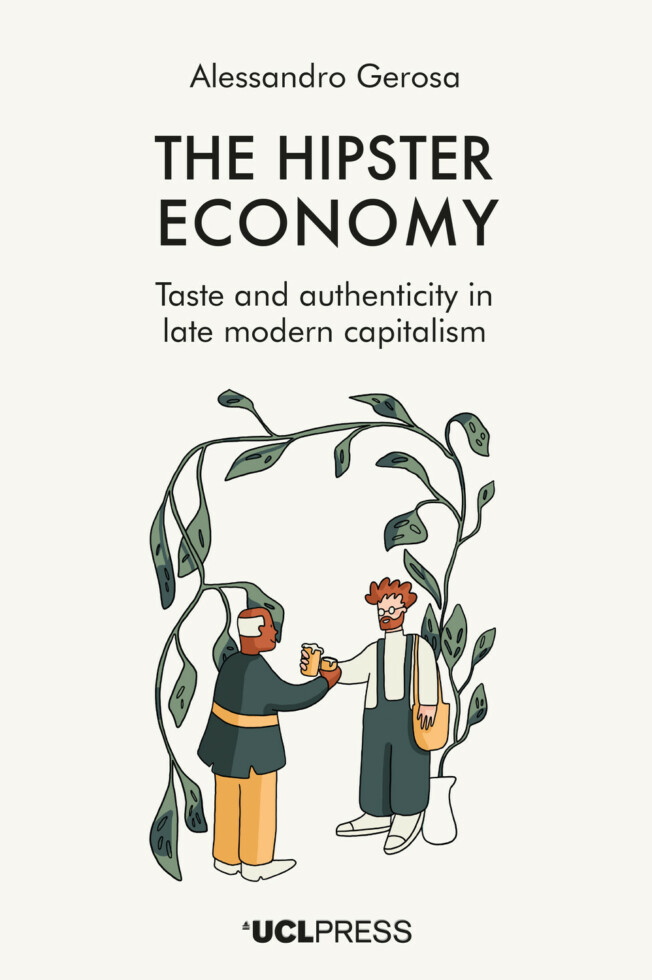
The Hipster Economy: Taste and Authenticity in Late Modern Capitalism
Today, being authentic has become an aspiration and an imperative. The notion of authenticity shapes the consumption habits of individuals in the most diverse contexts such as food and drinks, clothing, music, tourism and the digital sphere, even leading to the resurgence of apparently obsolescent modes of production such as craft. It also significantly transforms urban areas, their local economies and development. The Hipster Economy analyses this complex set of related phenomena to argue that the quest for authenticity has been a driver of Western societies from the emersion of capitalism and industrial society to today. From this premise, the book advances multiple original contributions. First, it explains why and how authenticity has become a fundamental value orienting consumers’ taste in late modern capitalism; second, it proposes a novel conceptualisation of the aesthetic regime of consumption; third, the book constitutes the first detailed analysis of the resurgence of the neo-craft industries, their entrepreneurs, and the economic imaginary of consumption underpinning them, and fourth, it analyses how the hipster economy is impacting the urban space, favouring new logic of urban development with contrasting outcomes.
Existing research has highlighted a global return into fashion of craft work in the new century. Within this context, the term ‘neo-craft’ work has been used to identify innovative craft work practices characterized by an aura of ‘coolness’, which promise a less alienated form of work; yet, the specific contours of this new form of work remain uncertain. In this article we develop a theoretical conceptualization of neo-craft work. We define it as an emergent form of post-industrial craft work whereby work that was previously considered low-status, or performed by the working class, is: (a) ‘resignified’ into status-producing activity through the integration of craft practices and values; and (b) conferred new meaningfulness as the outcome of a specific process of discursive materiality, by which the intra-action of discursive and material practices provides meaning to work activity. Neo-craft work, we contend, finds roots in the cultural milieu of hipster culture, where extenuating cultural negotiations around authenticity and ‘the particular’ constitute the baseline for a quest for social status based on practices of ‘marginal distinction’, and sets itself as an alternative not only to industrial work but, primarily, to the precarious, low-paid or otherwise unsatisfactory ‘bullshit jobs’ of the knowledge and creative economy.
2022
The resurgence of craft retailing: marketing and branding strategies in the food and beverage sector
Alessandro Gerosa
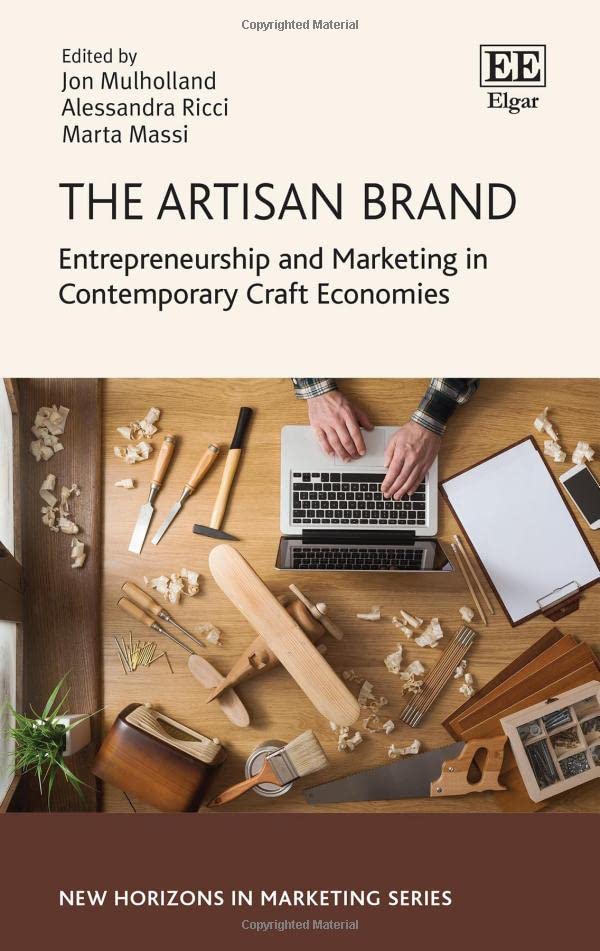
In The Artisan Brand: Entrepreneurship and Marketing in Contemporary Craft Economies, 2022
The twentieth century saw a decline in the social prestige and role of shopkeepers, stripped of their historical double function of retailers and artisans. Indeed, they lost their role as cultural actors, becoming relegated to mere economic intermediaries between mass production and consumers. However, recently the demise of Fordist economy and the development of the neo-craft industries paved the way to a resurgence of artisanal retailing, which relevance is confirmed both by a peculiar category of workers and shops and by the permeating brand of artisanal production in retailing. This chapter firstly contextualises and explains the cultural and economic processes that made this resurgence possible. Then, based on ethnographic research composed of participant observation notes and interviews with food and beverage micro-entrepreneurs, analyses the fundamental features of marketing and branding strategies enacted in the food and beverage neo-craft retailing.
2021
Cosmopolitans of regionalism: dealers of omnivorous taste under Italian food truck economic imaginary
Cultural omnivorousness has gained relevance as a suitable theory to explain contemporary patterns of consumption, but the actual dealing of omnivorous taste by economic actors and businesses has been mostly overlooked. Through ethnographic research, this article explores how Italian gourmet food truck operators concretely produce claims of authenticity for omnivorous seekers. First, the adoption of the perspective of food truck operators highlights the reflexive and market-bounded nature of the omnivorous taste reproduction. Moreover, “being authentic” becomes an imperative for tastemakers, imposed by the economic imaginary. Finally, the centrality of regionalism in the Italian production of authenticity suggests that localism, too, has been subsumed by global food imaginaries and that regionalism expresses a cosmopolitan attitude. Taken together, these findings allow the integration of existing theory of food cultural omnivorousness: “gourmet” food must be authentic to be recognised by omnivores and distinctive to be successful on markets.